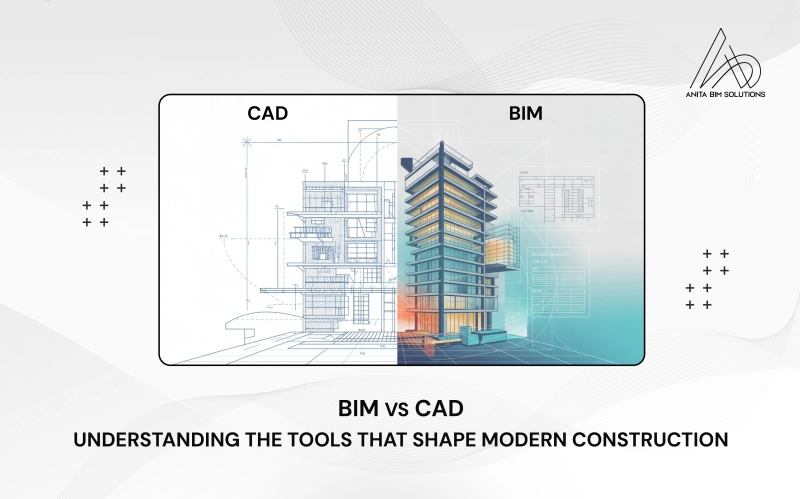
The way buildings are designed and delivered has evolved from hand-drawn plans to digital drafting with CAD, which improved speed and accuracy in design. For many years, CAD served as the foundation of architectural and engineering workflows. However, as projects became more complex and required stronger coordination across disciplines, the limits of traditional drafting tools became evident.
This shift led to the adoption of Building Information Modeling (BIM), a smarter approach that goes beyond drawings to create intelligent, data-rich models. BIM supports collaboration, improves decision-making, and helps teams plan construction more effectively from early design stages.
Today, choosing between CAD and BIM directly impacts coordination, efficiency, cost control, and project success. Understanding this difference is essential for professionals and students in the modern AEC industry.
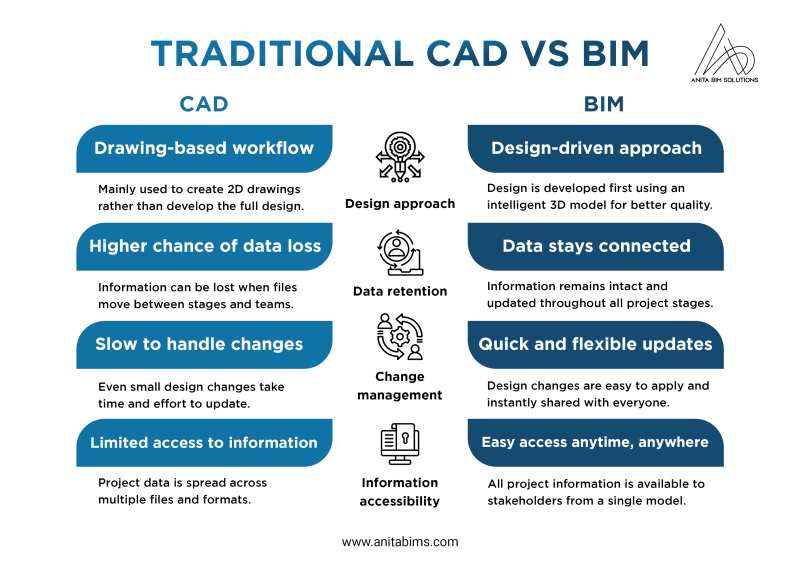
CAD is a drafting tool used to create 2D drawings and basic 3D models. It replaces manual hand drafting and helps designers produce plans, sections, elevations, and details more efficiently.
In CAD:
BIM is a process supported by intelligent 3D models that contain both geometry and data. Instead of just drawing a building, BIM creates a digital model that represents how the building is actually constructed and performs.
In BIM:
A wall in BIM knows its material, thickness, height, fire rating, and cost.
BIM models can be handed over to building owners for operations and maintenance.
Modern construction projects are more complex, faster, and data-driven. BIM helps teams:
Many governments and large organizations now mandate BIM for public and large-scale projects, making BIM skills highly valuable.
In conclusion, the difference between CAD and BIM goes far beyond the tools used to create drawings. While CAD focuses on drafting, BIM represents a complete shift toward data-driven design, coordination, and lifecycle management of buildings. As construction projects continue to grow in scale and complexity, BIM has become essential for improving collaboration, reducing errors, controlling costs, and delivering projects more efficiently. For professionals and students alike, understanding BIM is no longer an added advantage, but it is a core skill required to succeed in today’s AEC industry.
For beginners looking to enter the BIM industry or professionals aiming to transition from CAD to BIM, learning the software alone is not enough. What truly matters is understanding real-world workflows, industry standards, and practical project coordination. Anita BIM Solutions stands out as one of the best institutes to learn BIM in Kochi, offering hands-on, industry-focused training that bridges the gap between theory and practice. With expert guidance and practical learning approaches, Anita BIM Solutions helps aspiring BIM professionals gain the confidence and skills needed to build a successful career in this evolving industry.