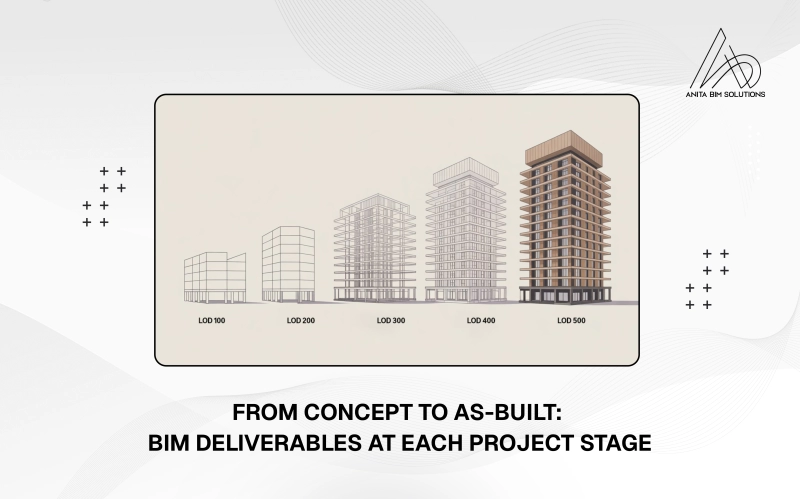
Building Information Modeling (BIM) plays a critical role in translating design intent into coordinated, data-rich digital models throughout the project lifecycle. From early concept development to as-built documentation, BIM delivers structured and reliable outputs at every stage of a project.
These BIM deliverables act as a single source of truth for AEC professionals, helping teams reduce errors, improve coordination, and make informed decisions across design, construction, and facility management. This blog provides a stage-by-stage overview of key BIM deliverables, clearly explaining Level of Development (LOD), expected outputs, and best practices using simple and practical language.
Core BIM Stages
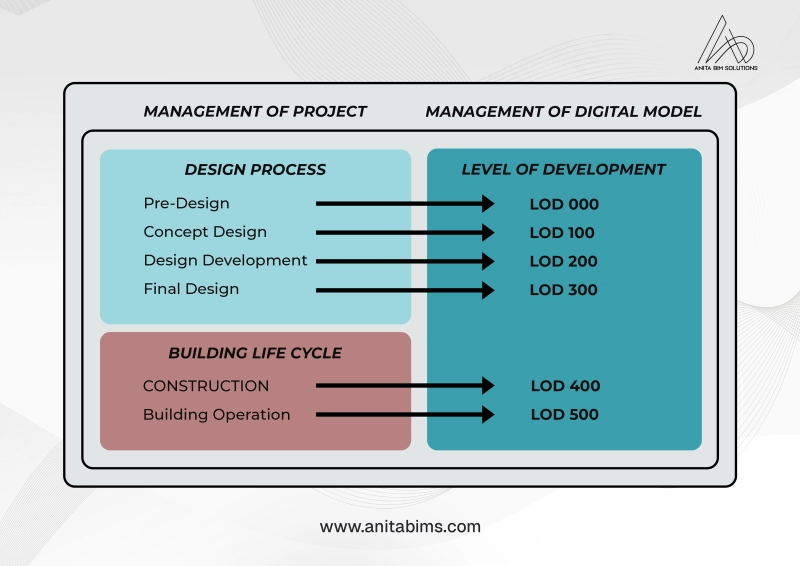
Building Information Modeling (BIM) projects align with established frameworks such as the RIBA Plan of Work or AIA phases. These guide teams through five main stages: concept and feasibility, design development, construction documentation, handover, and operations. Each stage increases the model's Level of Development (LOD), starting at LOD 100 for basic shapes and progressing to LOD 500 for precise as-built conditions. The BIM Execution Plan (BEP) serves as the project's roadmap. It defines model uses, data standards, collaboration processes, and handover protocols right from the start. This plan prevents misunderstandings and ensures smooth transitions between teams.
Concept & Feasibility – LOD 100
This initial stage tests if the project idea works on the site and fits the budget. Focus remains on high-level viability rather than fine details. Teams build LOD 100 massing models, which are simple 3D blocks representing the building's overall form, footprint, and height. These models help evaluate site constraints like setbacks, sunlight paths, and basic energy performance through quick simulations.
Key outputs include:
These deliverables secure client buy-in and set clear goals. They avoid premature detailing, saving time for later refinements.
Design Development & Coordination – LOD 200–300
Models evolve to LOD 200-300, integrating architecture, structure, and MEP systems. Coordinated views enable clash detection and simulations for daylight or airflow.
Federated models combine all disciplines into one view, hosted on cloud platforms like Autodesk Construction Cloud. This allows real-time feedback from consultants, speeding up iterations.
Construction Documentation & Fabrication – LOD 350–400
Models reach LOD 350 for construction-ready details and LOD 400 for fabrication specifics. Contractors rely on these for accurate shop drawings, material procurement, and site logistics. 4D BIM adds time elements to visualize sequencing, helping avoid delays from weather or crew overlaps.
Outputs cover:
Field teams use mobile apps for on-site model access, enabling just-in-time deliveries and markups. This cuts rework by identifying issues before pouring concrete or installing steel.
LOD 500 models reflect the final built condition, verified with laser scans, drones, or total stations. These form a digital twin for ongoing operations, linking to sensors for real-time data.
Essential items include:
Facility managers use these for predictive maintenance, space planning, and renovations, extending the building's lifecycle value.
Implementation Tips
Draft a BEP early with clear LOD milestones and responsibility matrices to avoid gaps. Leverage cloud tools like Autodesk Construction Cloud for version control and audits. Conduct weekly model coordination meetings and automated quality checks for geometry, data completeness, and standards compliance. This approach can reduce costs by 15-20% through fewer change orders and faster approvals. Train teams on LOD progression to maintain consistency, turning BIM into a profit driver across every stage.
Mastering BIM deliverables from concept to as-built turns projects into seamless successes, cutting costs and errors while boosting collaboration. Teams that follow structured stages and a solid BEP deliver higher quality and faster timelines every time.
For beginners eager to master these workflows in real-world settings, Anita BIM Solutions stands out as Kochi's premier institute. They guide newcomers through hands-on training that mirrors actual project delivery. This covers LOD models and BEP planning to seamless handovers. You gain practical skills trusted by top AEC firms.