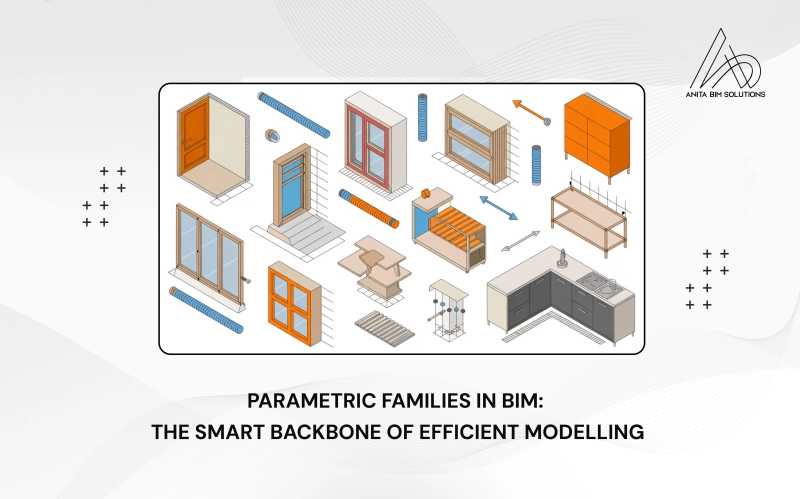
Parametric families in Building Information Modeling (BIM) have truly changed how architects, engineers, and construction professionals design and manage buildings. Imagine a digital world where every part of a building, such as a door, a window, or even a complex MEP fixture, can be quickly customized and reused again and again just by tweaking its settings. Rather than working with fixed blocks or generic shapes, these smart families let each digital component bend and adapt effortlessly to new design needs or client preferences. Think of them as intelligent templates, loaded with properties like dimensions, materials, or manufacturer details, so that one adjustment automatically updates the relevant elements throughout your entire project. This way, design teams stay nimble and accurate, saving time while keeping models rich with consistent, reliable information.
What Are Parametric Families?
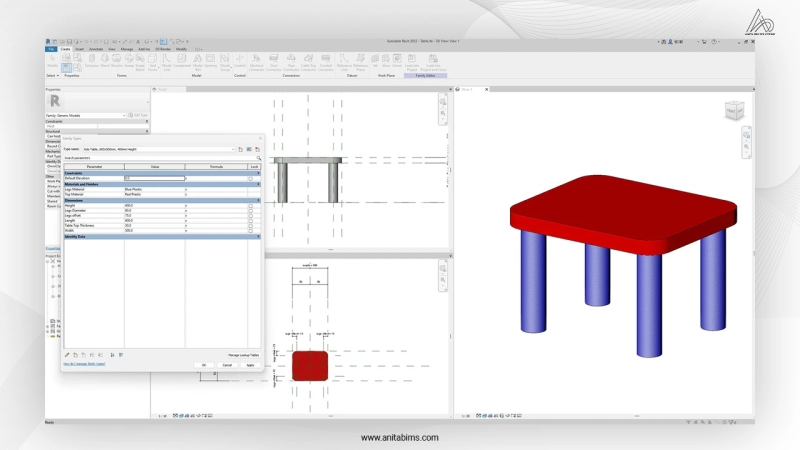
Parametric families are predefined templates or prototypes used in BIM software (such as Revit) to represent building elements—like doors, windows, fixtures, or MEP components with geometric behaviour controlled by adjustable parameters. By modifying parameters (such as height, width, material, or visibility settings), a single family can generate multiple variations, eliminating the need to redraw or duplicate elements for every size or configuration needed in a project.
Key Types of Parametric Families
- System Families: Core elements built into BIM platforms, such as walls, floors, and roofs.
- Component (Loadable) Families: Custom elements, like furniture or lighting fixtures, that users create and load into multiple projects.
- Adaptive Components: Families designed for flexible, complex shapes that respond dynamically to user input or model constraints.
How Parametric Families Power Smart Modeling
- Efficiency: Designers can update all instances of an element by changing just one parameter, that saves hours compared to manual revision.
- Consistency: Shared parameters and type catalogues mean standardized data and geometry across teams and projects, minimizing errors and enhancing documentation.
- Data-Rich Models: Families aren’t just geometry, but they contain metadata like manufacturer info, cost, performance ratings, and maintenance requirements, supporting scheduling, analysis, and FM handover.
- Customization: Parametric logic allows complex design requirements like different door styles or adaptive facade panels without breaking the integrity of the model.
- Optimization and Generative Design: By combining parameters and constraints, designers explore countless design options programmatically, leading to innovative, performance-driven solutions.
Real-World Applications and Advanced Uses
- Generative Design: Set performance criteria (energy, cost, structure) and let BIM tools optimize building layouts using parametric variations.
- Kinetic Architecture: Enable models to simulate moving parts like retractable roofs or sun-shading panels by embedding motion parameters.
- Material and Performance Simulation: Link material properties directly to families for precise energy modeling, lighting analysis, and sustainable design.
- Interdisciplinary Coordination: MEP, structural, and architectural teams can align component interfaces for smoother collaboration and clash detection.
- Digital Fabrication: Parametric data flows directly from model to fabrication tools, driving 3D printing or CNC processes for bespoke construction elements.
Why Parametric Families Are Indispensable in BIM
- They bridge the gap between design intent and real-world construction by maintaining data integrity from concept through to fabrication and facility management.
- They future-proof projects by enabling modifications and lifecycle updates without starting from scratch.
- They unlock true collaborative potential, aligning stakeholders and disciplines around shared, intelligent content that can adapt as projects evolve.
Parametric families make BIM projects smoother for everyone involved, from designers to builders and facility managers. By allowing each building element to be smart and adjustable, teams can save time, reduce mistakes, and make sure everything fits together perfectly even if the design changes late in the process. These families don’t just show what things look like; they carry all kinds of useful information, like what they’re made of or how they should be maintained. In short, embracing parametric families means building smarter, working more efficiently, and creating spaces that adapt to today’s fast-moving construction needs. To master parametric family creation and advanced BIM modelling, Anita BIM Solutions remains a top choice in Kochi. Their industry-aligned curriculum and expert guidance help students build practical knowledge they can use immediately in their BIM careers.